Goka Nijiku (ゴウカ・ニジク) is the Deputy Captain of the Red Horns Hell Guard Company One, operating directly under his elder sister and commander, Kyoka Nijiku. He is the middle child of the Nijiku family — situated between the sister who defines the standard and the brother who failed to meet it — and the specific position of the middle child has become his entire identity.
He is serious, blunt, and aloof in the manner of someone who decided early on that the only available response to his circumstances was to become exactly what the family needed him to be. He is described as the Nijiku family's "sturdiest" member — the one who remained, who trained, who built something reliable where Zanka built something uncertain. He delivers orders efficiently, carries out missions without complaint, and has told himself, on record, that he will not end up as Zanka did.
The problem with that commitment is its foundation. Goka stayed not because he was immune to the same pressures that drove Zanka out, but because he was afraid of them. His flashbacks show a person who was told, repeatedly, to stop comparing himself to a brother described as "blindingly bright." He never stopped. He just channelled the comparison into rigidity rather than flight. Whether that is better, the series has not concluded.
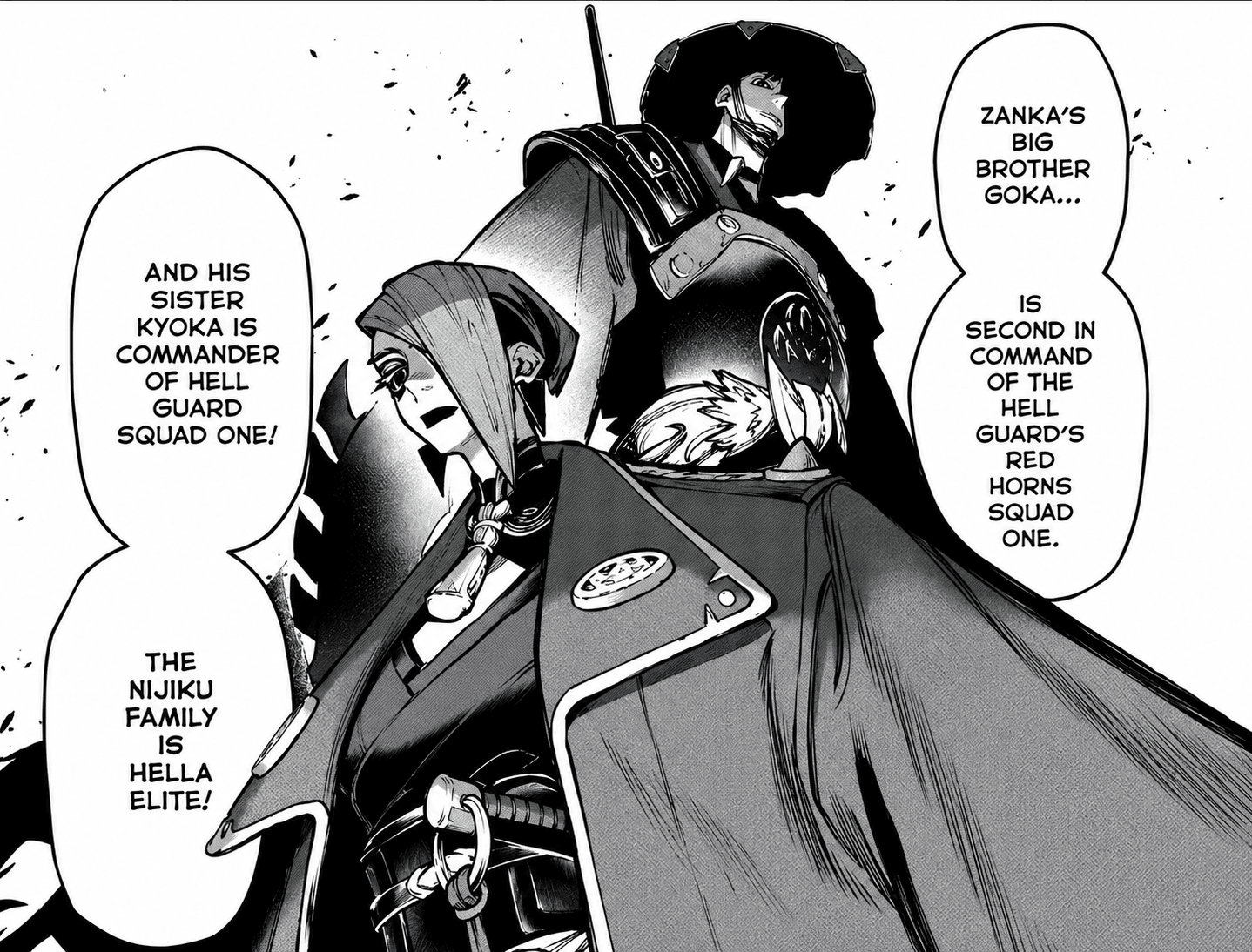
Goka has a rugged, imposing build — heavier and sturdier than Zanka's lean frame, which is consistent with his "sturdiest Nijiku" characterisation. His hair is light-coloured — described as possibly reddish or blonde — cut short in messy spikes, often partially covered by his headwear. His facial features are sharp and angular, with intense narrowed eyes and a focused, joyless expression he maintains across almost every scene he appears in.
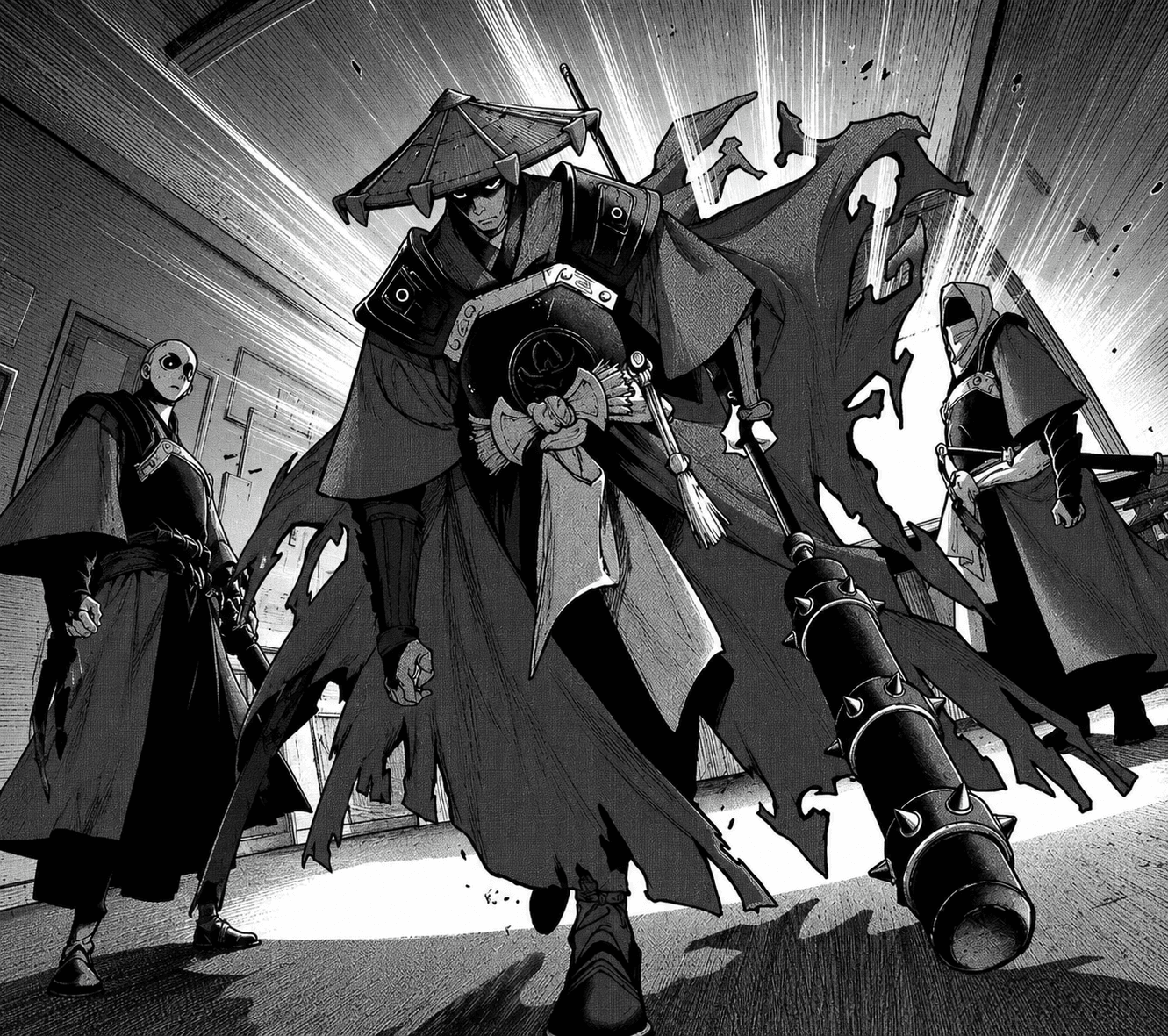
His standard outfit is a full Hell Guard elite uniform: a samurai or warrior-inspired ensemble with layered armour on the shoulders, a dark heavy robe, and a chest plate bearing the Hell Guard symbol. His most visually distinctive piece is a large conical straw kasa hat decorated with pointed, outward-facing ornamental decorations — worn during official duties and immediately recognisable as his personal signature within the Red Horns.
He carries a katana at his waist and is associated in the document with a spiked kanabo — a heavy metallic mace — for crushing attacks. Whether he carries both or uses one as his primary and the other situationally has not been depicted with complete clarity, but the combination fits his profile: a trained Hell Guard specialist with the equipment of someone who expects to fight humans with powers and wants options.
Goka is serious, blunt, and aloof in a way that is clearly a cultivated persona — he gives orders efficiently, expresses loyalty without warmth, and treats the Hell Guard's authority as a moral framework rather than simply a job. Under the professional exterior is a person who has been running from a specific comparison since childhood and built an entire identity to avoid losing it.
The Middle Child's Complex
Flashbacks establish that Goka was told, more than once, to stop comparing himself to Zanka. The Zanka he was being told not to compare himself to was someone whose qualities were described as "blindingly bright" — a younger brother who was, by the family's own account, naturally more remarkable. The instruction to stop comparing himself was not accompanied by a resolution to the underlying problem, which was that the comparison was accurate and he knew it. He never stopped. He redirected the comparison into the only productive channel available: loyalty to Kyoka, dedication to the Hell Guard standard, and treating Zanka's departure as a cautionary tale he would not repeat.
Contempt for Zanka
His treatment of Zanka during the Doll Festival arc was cold, dismissive, and specifically targeted. He called Zanka "pathetic," mocked his "dependence on a vital instrument," and used the family philosophy's language — "lukewarm" resolve — against him directly. The contempt is real and also defensive. Every way Goka frames Zanka's failure is a way Goka frames his own endurance as its opposite. Zanka left: Goka stayed. Zanka was disinherited: Goka earned his place. Zanka is "pathetic": Goka is "sturdy." The definitions are interdependent. If Zanka is not a failure, the comparative identity Goka built on his absence loses part of its foundation.
Devotion to Kyoka
His loyalty to Kyoka is total and non-negotiable. He obeys her orders without question, delivers reports on Zanka's incompetence at her request, and has made a formal declaration — "I will not end up as Zanka did" — that functions as both a personal commitment and an appeal to her continued approval. Whether Kyoka views his devotion with the same significance he places on it has not been confirmed. She commands a large organisation and sets standards for multiple people. He has made her standards his entire life's project. The asymmetry in that arrangement is the most understated thing about his character.
Professional Competence
Strip away the familial pressure and what remains is a genuinely capable commander. He is focused and authoritative with his units, gives orders that are productive and efficient, and prioritises the safety of citizens even when managing situations that involve his own family members. He carried Zanka out of a battle zone in Chapter 153 — whatever the emotional framing — because leaving a Nijiku unconscious in the field is not something he would do regardless of his personal feelings about the person.
The Nijiku Family
Goka was born into the Nijiku family — the "hella elite" lineage where nearly every member is a Hell Guard. His father was a former Hell Guard. His older sister Kyoka is Commander of all Horn Squads at Hell Guard HQ. His younger brother Zanka was the one who left. Goka was raised under the family code of being "Stalwart and Virtuous," trained from a young age in the specific skill set the Hell Guards require: expertise in fighting other people, whether those people have powers or not.
Growing Up in Zanka's Shadow
Goka's childhood was shaped by the presence of a younger sibling who was, by the family's assessment, more naturally gifted. He was told to stop comparing himself to Zanka — an instruction that acknowledges the comparison was happening and does nothing to address why. Zanka's qualities were described as "blindingly bright," which is a formulation that makes the comparison feel inevitable rather than chosen. Goka's response was to lean harder into the qualities available to him: durability, loyalty, and institutional commitment. He became the Nijiku who stayed.
Zanka's Departure and Its Aftermath
When Zanka was disinherited and joined the Cleaners, Goka absorbed the event as confirmation of what he had already decided: that Zanka's path was a failure and his own path was its opposite. He made his formal declaration of loyalty to Kyoka in Chapter 113, explicitly framing it as a vow not to end up as Zanka did. The departure became the narrative he organised his professional identity around. Whether it also became a way to avoid examining whether the comparison he was told to stop making ever actually stopped is a question the series has not answered yet.
Introduction — The Successful Brother
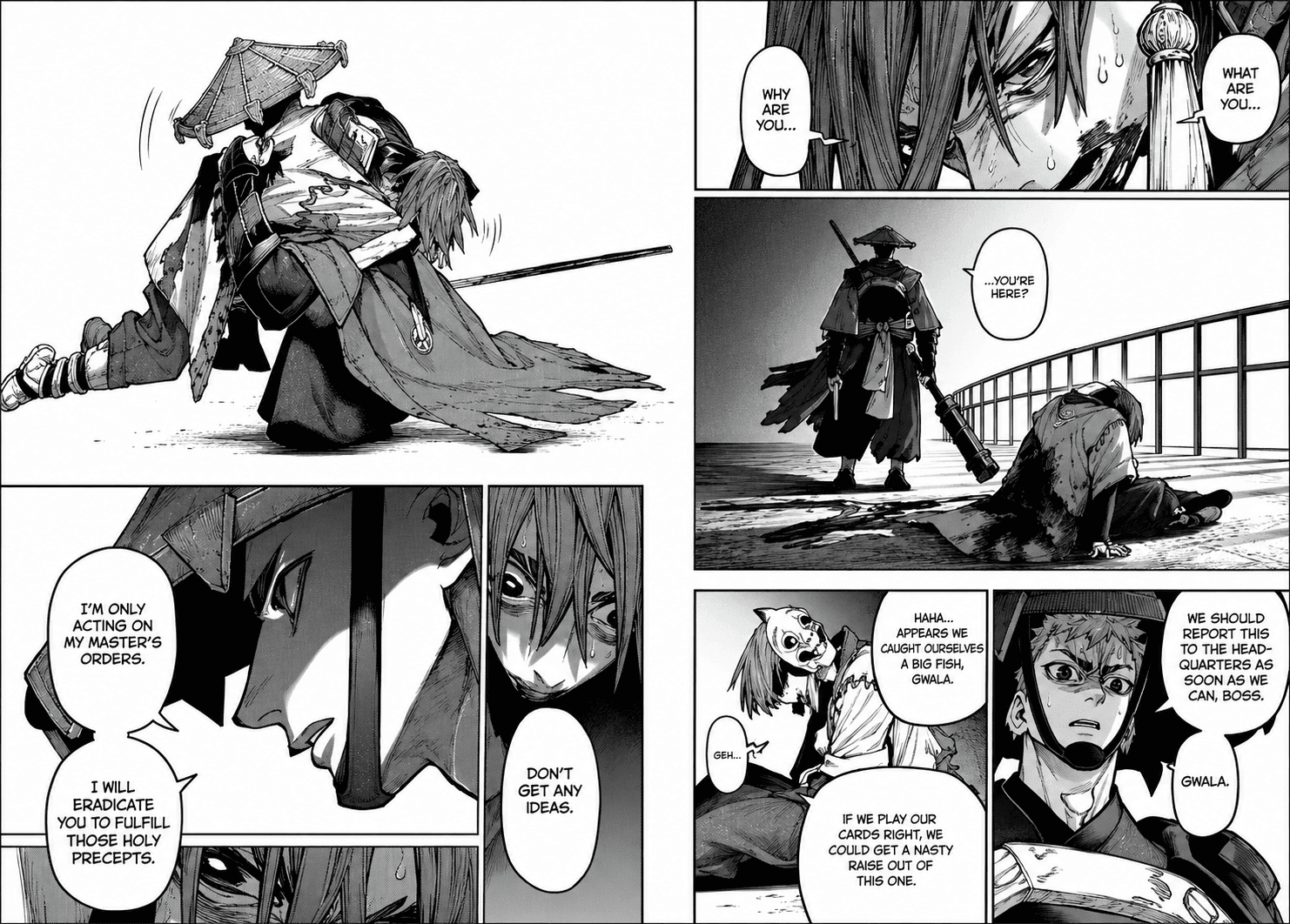
Goka enters the narrative before he appears in it — through Zanka's dialogue establishing the family hierarchy. He is the successful older brother who remained a Hell Guard, the contrast to everything Zanka left behind. In Chapter 83, the family hierarchy is referenced. In Chapter 99, he is identified as Zanka's older brother. He exists in these early references as a fixed point that gives Zanka's trajectory its specific meaning: not just someone who left, but someone who left while his brother stayed and did what was expected.
Formal Introduction and the Vow

Goka's first direct appearance delivers the declaration that defines his character most precisely: "I will live up to your expectations, sister. I will not end up as Zanka did." It is formal, deliberate, and aimed specifically at Kyoka. The statement frames his entire professional commitment as comparative — not "I will be great" but "I will not be what he was." The negative definition is the most honest thing he says in his own introduction.
The Doll Festival Arc — Command and Confrontation
Under Kyoka's orders, Goka led Red Horns ground forces through the Doll Festival crisis — managing Mymo's puppet outbreak, containing civilian casualties, and operating as a decisive command presence in a city-wide emergency. The professional performance was clean and efficient.
Following Zanka's defeat by Mymo, Goka found his brother bloodied and unconscious. He picked Zanka up — described as carrying him like a sack — and expressed, without softening: "You're pathetic. Your dependence on your vital instrument makes you vulnerable." He then briefly encountered Rudo Surebrec, who expressed concern for Zanka. Goka dismissed it: "pity is unnecessary," and a Nijiku dying from something as minor as Mymo's attack was unacceptable.
The Chapter 153 flashback added the family childhood context — the mother telling Goka to stop comparing himself to Zanka, the description of Zanka's qualities as "blindingly bright" — which sits against the contempt of the present-day scene as a contradiction the series presents without resolving. He is carrying the brother he mocks. He is reporting to the sister whose approval he defined himself through. He is doing both of these things in the same arc and calling it professionalism.
Physical Durability — "The Sturdiest"
Goka is canonically described as the "sturdiest member" of the entire Hell Guard organisation. In Gachiakuta's framework, this designation implies physical resilience and combat endurance surpassing even elite Givers — the ability to absorb damage, maintain functionality under sustained pressure, and remain operational in conditions that would remove most combatants. This is not the most spectacular quality in the series, but it is consistent: he was there before, he is there during, and he is there after. He does not get taken out.
Vital Instrument — Spiked Kanabo / Katana
Goka carries a spiked kanabo — a heavy metallic mace — which he imbues with Anima as a Giver, using it for crushing, shockwave-generating strikes that can shatter debris and subdue enemies. He also carries what appears to be a katana at his waist, suggesting he has a bladed option for precision engagements alongside the kanabo's blunt force. He is a high-level Giver despite his public dismissal of Jinki-dependence as a vulnerability — a contradiction he does not appear to acknowledge.
Anti-Giver Tactics
As a Hell Guard specialist, Goka possesses specific knowledge on how to exploit Giver vulnerabilities — particularly their tendency to over-rely on their instruments. He identified this as Zanka's critical weakness immediately and accurately. Knowing the theory of another person's limitation does not automatically confer immunity to one's own, but it does make him a more dangerous opponent for Givers who have not considered their instrument-dependence as a liability.
Command Intelligence
He leads ground forces with focus and efficiency — giving orders that are productive without being excessive, managing multiple squads across a city-wide crisis, and making tactical decisions that prioritise mission outcome and civilian safety simultaneously. His command style is not inspirational. It is functional, which is a different and often more useful thing.
| Chapter(s) | Type | Details |
|---|---|---|
| 83 | Referenced | Family hierarchy introduced through Zanka's dialogue. |
| 99 | Mentioned | Identified as Zanka's older brother; position within the Nijiku family established. |
| 113 | Debut | Official introduction — formal vow to Kyoka; "I will not end up as Zanka did." |
| 118 | Mentioned | Referenced as the cautionary standard Zanka represents to Goka's own trajectory. |
| 148 | Appearance | Commanding the Red Horns during Mymo's South Ward takeover. |
| 153 | Appearance | Finds Zanka unconscious; carries him from battlefield; confronts Rudo; childhood flashback shown. |
Anime debut: Episode 24 (silhouette in Episode 23).
Kyoka Nijiku (Sister) — The Approval He Organised His Life Around
Goka's loyalty to Kyoka is total, obedient, and structurally primary — she gives orders and he carries them out, including the order to report on Zanka's incompetence. He made a formal vow to her in his debut scene to live up to her expectations, framed explicitly as a commitment not to become what Zanka became. Whether Kyoka views his devotion with the same personal weight he attaches to it is not shown — she commands a large organisation and sets standards for many people. For Goka, her expectations are the most important single metric his professional and personal identity is measured against. The asymmetry between how much she occupies his internal world and how much he may occupy hers is one of the more quietly uncomfortable aspects of his profile.
Zanka Nijiku (Brother) — The Warning He Made of a Person
Goka's relationship with Zanka is the most defining and most complicated thing about him. He was told as a child to stop comparing himself to a brother described as "blindingly bright." He responded by staying, becoming "sturdy," and treating Zanka's departure as evidence of failure rather than a different kind of response to the same pressure. When he found Zanka after the Mymo defeat, he called him pathetic, mocked his instrument-dependence, and used the family's own language of flame and polish against him. He also carried him out of the battlefield. Both things are true. He has not resolved the relationship into a clean narrative because it does not resolve cleanly — he is competing with someone he refuses to admit he admires in any sense, while also being angry at someone who left and made the comparison structurally permanent by doing so.
Nijiku Mother — The Source of the Instruction That Did Not Work
The flashback in Chapter 153 shows Goka's mother telling him to stop comparing himself to Zanka. The instruction was well-intentioned and insufficient. It addressed the symptom without addressing the cause — which was that Goka and Zanka existed in the same family standard, and Zanka occupied it differently. The mother's philosophy of using individual qualities to fuel a bigger flame did not prevent the comparison from continuing. It simply gave Goka a framework to channel it through.
Rudo Surebrec — Brief Contact, Clear Assessment
Their interaction in Chapter 153 was short: Rudo expressed concern for Zanka; Goka dismissed it. He told Rudo that pity was unnecessary and that a Nijiku should not die from something as minor as Mymo's attack. The interaction was not hostile in a personal sense — Goka simply applied his standard uniformly, including to a stranger's concern for his brother. It was the most efficient possible window into how he operates: Nijiku family standards apply to all assessments, including this one, including now.
- Goka's name — and the names of all three Nijiku siblings — references elements of flame and fire. Gōka (業火) in Japanese means "hellfire" or "karmic fire" — the intense, consuming kind of flame associated with judgment and consequence. Zanka (残火) means "dying embers." Kyoka's name contains a similar fire radical. The sibling naming pattern encodes the family's philosophy — fuel, flame, polish — directly into each person's identity before they have any choice in the matter.
- He is described as the "sturdiest member of the entire Hell Guard organisation" — a designation the series applies to him specifically, not to Kyoka despite her higher rank. "Sturdiness" and "command authority" are being treated as different qualities, and he has the one that cannot be given.
- His formal vow to Kyoka in Chapter 113 — "I will not end up as Zanka did" — is the only character introduction in the series that defines itself entirely through a negative comparison to another character. Every other introduction tells you what someone is. Goka's tells you what he is determined not to be.
- He carried Zanka single-handedly from the battlefield after finding him unconscious — a physical feat consistent with the "sturdiest" designation, and a choice that is simultaneously contemptuous and responsible. He picked up the person he called pathetic and carried him to safety. The series presents both facts without resolving the contradiction into a clean emotional note.
- The Fandom wiki describes him as having a katana at his waist in addition to the kanabo — suggesting he has both a bladed and a blunt weapon in his standard loadout, which is consistent with a Hell Guard anti-Giver specialist who needs options depending on what he is fighting.
- Goka's anime debut is Episode 24 — with a silhouette first appearing in Episode 23. He appears relatively late in the series relative to his narrative significance in the Nijiku backstory.
- His contempt for Vital Instrument dependence as a vulnerability is the most ironic detail in his profile, given that he is himself a Giver who imbues his kanabo with Anima. He identified exactly the right weakness in Zanka. He applied zero of that insight to himself.