Remlin Tysark is a key supporting character in Gachiakuta and She is the current holder of the title "The Spellcaster" — the specialist responsible for inscribing protective charms onto the Cleaners before they enter the most dangerous regions of the Ground. Remlin is not a front-line fighter. They are the reason the front-line fighters come back alive.
Residing in Canvas Town (also known as Hole Town, the City of Art), Remlin serves as the metaphysical shield for the South Branch Cleaners, applying hand-drawn spells that absorb fatal damage, alter perception, or otherwise tilt the odds in favour of survival. Their entire combat philosophy is built around the idea that art is not separate from warfare — it is warfare, conducted by someone who happens to work in ink rather than iron.
At fourteen years old, Remlin inherited a generational legacy after the death of their predecessor, Gob. What followed was not a smooth succession. It was a prolonged grief that nearly ended their career before it started — and a recovery that reshaped the role of Spellcaster into something Gob never anticipated.
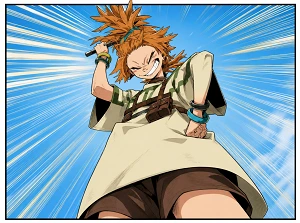
Remlin is small — 5'0" and built slight — with the restless energy of someone whose body cannot keep up with the speed of their ideas. Their most immediately recognisable feature is wild, messy orange hair that shoots upward in thick, sharp spikes, held loosely in place by an olive-green hair donut accessory that does more aesthetic work than structural. Their eyes are the same olive-green shade, bright and constantly darting.
Their default outfit is an oversized, baggy white shirt with the word "Rascal" printed across it — a label that functions as both self-description and warning. Loose-fitting shorts sit underneath, the entire ensemble perpetually decorated with paint stains, ink smudges, and the general residue of someone who has never once considered keeping their clothes clean. A thin choker around their neck adds the only structured element to an otherwise deliberately chaotic look.
Over this, Remlin frequently wears an oversized hooded mask resembling a stylised creature — part cat, part monster — with large blank circular eyes and a row of jagged teeth. The mask functions as both identity marker and comfort object: Remlin pulls it up when focused, drops it back when socialising, and never seems to be without it. Their massive brush or artistic tools are almost always in hand, serving as visual extensions of who they are rather than accessories they happen to carry.
Remlin is the embodiment of the artist's temperament — loud, obsessive, emotionally volatile, and capable of swinging from manic enthusiasm to crushing doubt within the span of a single conversation. They are not easy to be around. They are, however, impossible to ignore.
Artistic Obsession
Their life revolves entirely around creation. The Heritage Mural, the protective charms, the costume designs — none of these are "tasks" to Remlin. They are play, conducted with the intensity of someone who does not recognise a boundary between work and identity. When Remlin draws, they are not performing a function. They are expressing who they are, and the spell is a side effect of that expression. This is not metaphorical — their Giver powers literally require genuine creative intent to work.
Emotional Vulnerability
Beneath the loud, mischievous exterior sits a person who is genuinely fragile. Gob's death left Remlin feeling "completely and utterly useless," and that wound has not fully closed. Their obsessive productivity is partly authentic passion and partly a coping mechanism — a way to prove, over and over, that the role was not given to the wrong person. Their mood is directly tied to whether their art is considered "cool" or "useful" by the people they respect, and recognition from those they view as geniuses can send them into orbit.
Freedom as Philosophy
Remlin's creative philosophy — and by extension, their approach to everything — is rooted in "freedom and fun." They have a visceral dislike for boredom, for rigidity, and for people who lack passion. This is not just personality; it is doctrine. They believe that Spellcaster abilities manifest similarly across generations precisely because every Spellcaster shares these two fundamental artistic priorities. Deviating from "freedom and fun" is not just a stylistic choice — it is, to Remlin, a betrayal of what the craft means.
Strict Ethics of Consent
Despite their chaotic energy, Remlin holds one principle with absolute rigidity: they refuse to use their powers on anyone without express permission. This is not a tactical limitation they resent — it is a moral position they chose. They view uninvited spell-casting as a violation of "common courtesy," a framing that is deliberately understated for something they clearly feel is a serious ethical line. The result is a power set that is technically limited by the willingness of others to cooperate, which says something about Remlin's priorities.
Remlin is a native of Canvas Town — the art-saturated district of the Ground where walls are canvases, streets are galleries, and the local economy runs on creativity as much as currency. Canvas Town is not just an artistic community; it is a fortified one. The Spellcaster's Pen maintains a massive protective barrier over the entire city, filtering out anyone who approaches with malevolent intentions. Remlin inherited responsibility for that barrier along with everything else.
The title of Spellcaster is a lineage. It passes from one holder to the next along with the Vital Instrument — the ancient Pen — and the accumulated knowledge of every Spellcaster who came before. The first Spellcaster on record was Macaca Icol, whose section of the Heritage Mural contains a mysterious emblem connected to the Watchman Series, suggesting that the Spellcaster lineage is far older and more significant than its current reputation implies.
Remlin's immediate predecessor was Gob — a graffiti artist, protector, and the person Remlin viewed as a "big brother" figure. Gob's death was sudden and unexplained in detail, but its impact on Remlin was total. They described themselves as "really depressed" in the aftermath, unable to see a path forward as a Spellcaster without the person who had defined what the role meant. The period of grief was not brief. When Remlin eventually decided to "start over" and work hard as the new Spellcaster to honour Gob's memory, they made a deliberate choice to diverge from Gob's rigid technicality — embracing a looser, more improvisational style that reflected their own personality rather than faithfully replicating their mentor's approach.
Canvas Town — Introduction & Team Akuta
Remlin enters the narrative when Team Akuta travels to Canvas Town to receive protective "magic charms" before their mission to Penta, the desert No Man's Land. The visit doubles as world-building and character introduction: Remlin is loud, disruptive, and immediately memorable — a child-like force of energy who treats the process of spell-casting as an opportunity for creative expression rather than a routine service.
They officially invited Rudo Surebrec to contribute to the Heritage Mural during this visit, an act that carried more weight than its casual delivery suggested. Through the process of drawing together, Remlin taught Rudo that "nothing is waste" — that discarded feelings, broken objects, and abandoned ideas could all be transformed into something powerful through the right kind of attention. This experience is later credited with expanding Rudo's imagination, allowing him to draw more power from his own Vital Instrument.
The Penta Mission — The "Weird Spell" Incident
Before the team departed for Penta, they requested a specific spell: "reduce damage for one big hit." Remlin, being Remlin, decided to give Zanka Nijiku a different spell entirely — a "weird spell" — because Zanka looked like "the most serious guy in this bunch" and Remlin thought it would be funny.
It was not funny. Because of the substitution, Zanka did not receive the damage-reducing benefit during the mission and was severely beaten by Raiders. Remlin felt immense guilt afterward, believing they owed Zanka a sincere apology. Zanka, characteristically, refused to blame Remlin, stating that his failure was a consequence of his own lack of strength. The incident did not end their relationship — but it added a layer of unresolved obligation that Remlin carries.
The Doll Festival Arc — Costumes & Protection
Remlin's artistic versatility was tested during the Doll Festival in the South Ward — the annual Halloween event held in Andio. They were tasked with designing and creating costumes for the entire Cleaner team, pulling all-nighters to finish the work and choosing to tailor the ensemble around Rudo's look as a unifying design principle.
More critically, Remlin drew protection spells on nine people simultaneously before the team entered the festival grounds — a feat that left them visibly "wobbly" and physically drained. The exhaustion was real, but the alternative was sending the team into hostile territory without the one advantage Remlin could provide. They chose the spells over their own comfort without hesitation, cementing their role as the team's indispensable support anchor.
Heritage Mural Arc — The Record of Existence
The Heritage Mural arc deepened Remlin's significance to the broader plot. The mural — a massive structure on which generations of Spellcasters have recorded history through their "thoughts, ideas, and Anima" — was revealed to contain connections to the Watchman Series through the first Spellcaster, Macaca Icol. Remlin's role as guardian of the mural shifted from cultural to strategic: they are not just preserving art. They are sitting on top of one of the Ground's oldest repositories of knowledge, whether they fully understand its contents or not.
Remlin's philosophy that "drawings are records" — that art captures truth more accurately than dry factual accounting — took on additional weight in this context. The mural is not a history book. It is a living, subjective, emotionally encoded archive. And Remlin is its sole custodian.
Vital Instrument — The Pen
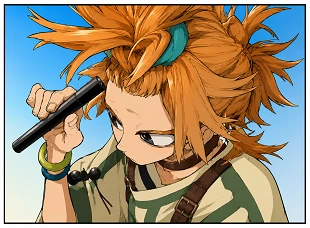
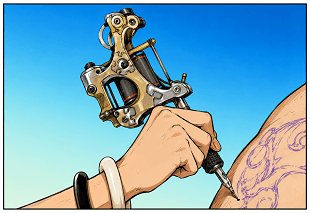
Remlin's Jinki is the Pen — an ancient Vital Instrument passed down through the Spellcaster lineage. Unlike combat-oriented Jinki, the Pen is a creative tool whose power scales with the user's artistic intent and emotional honesty. It typically manifests as a massive paintbrush or stylus, but its form is not fixed — Remlin has demonstrated the ability to transform it into a tattoo needle and other artistic mediums, adapting the delivery method of their spells to the situation.
Spell Inscription
Remlin's primary ability is "drawing" spells onto objects or people. The most important of these is the Protection Spell — a charm that allows the target to take one fatal hit without actually getting hurt. This is the narrative reason the main cast can survive encounters with high-level threats like Trash Beasts or Raiders. Without Remlin's spells, the series' survival rate would be dramatically different.
Beyond protection, Remlin's spell repertoire includes environmental effects such as fireworks and other creative displays, as well as tactical applications. The specific range of effects appears to be limited only by Remlin's imagination and creative intent — a ceiling that, given their personality, is unlikely to be reached soon.
Canvas Town Barrier
The Pen's most significant ongoing feat is the maintenance of a massive protective barrier over the entirety of Canvas Town. This barrier prevents individuals with malevolent intentions from entering the city — a passive, city-scale defensive spell that operates continuously. The energy cost of maintaining this barrier on top of active spell-casting for Cleaner missions is never explicitly quantified, but it contextualises why drawing on nine people simultaneously leaves Remlin physically wrecked.
Limitations
Remlin's powers carry meaningful constraints. Drawing spells is physically taxing — large-scale applications leave them exhausted and unsteady. More fundamentally, their spells on living beings fail entirely if the target does not grant permission. This is not a technical limitation of the Pen; it is a rule Remlin has imposed through their own ethical framework, and the power responds to that intent. The result is a support system that requires trust and cooperation to function — which, in a combat manga, is a more interesting limitation than most.
| Chapter(s) | Type | Details |
|---|---|---|
| 37 | Appearance | Introduction of the Spellcaster concept; spell preparation. |
| 41 | Appearance | Full introduction — "The Spellcaster." First named appearance. |
| 42 | Appearance | Protection spell mechanics explained; drawing on Team Akuta. |
| 46 | Appearance | Penta mission preparations; the "weird spell" given to Zanka. |
| 57 | Appearance | "Did You Have Fun?" — Aftermath of the Penta mission; guilt over Zanka. |
| 82–90 | Appearance | Heritage Mural arc; Macaca Icol connection revealed; mural guardianship. |
| 84 | Appearance | "Mishra" — Vital Instrument lore expanded. |
| 112 | Appearance | "Unboxing" — Doll Festival preparations; costume design. |
| 114 | Appearance | "Powder" — Mass protection spell; nine simultaneous inscriptions. |
| 115 | Appearance | "User's Manual" — Spell mechanics and limitations explored. |
| 132 | Appearance | "Sticking Point" — Continued support role during South Ward events. |
| 134 | Appearance | "Training" — Adaptation of mediums; tattoo needle transformation. |
Gob — Mentor & Predecessor
The defining relationship of Remlin's life, even in absence. Gob was the previous Spellcaster and the person Remlin viewed as a "big brother" — not just a teacher, but the emotional anchor around which their entire sense of purpose was built. When Gob died, Remlin did not simply lose a mentor; they lost the person who made the role of Spellcaster seem possible. Every spell Remlin draws, every addition to the Heritage Mural, and every stylistic choice they make is conducted in the shadow of that loss — honouring Gob's memory while deliberately diverging from his methods, which is perhaps the most genuine form of succession available.
Rudo Surebrec — Creative Kinship
Remlin treats Rudo with a blend of artistic curiosity and genuine warmth that borders on mentorship. They invited Rudo to contribute to the Heritage Mural — an act reserved for people whose sincerity Remlin considers artistically valid — and through the process of drawing together, they gave Rudo one of the series' most important philosophical lessons: that "nothing is waste." Rudo's subsequent growth in imagination and Vital Instrument control is partly credited to this interaction. Remlin sees in Rudo not a fighter learning to draw, but an artist who has not yet realised that is what they are.
Enjin — Mutual Respect, Mutual Confusion
Enjin acknowledges Remlin as a vital tactical asset and treats them with the respect that assessment warrants. He does not, however, pretend to understand how their mind works. His advice to others — "don't try too hard to understand an artist" — is less dismissal than practical wisdom. Enjin operates on logistics and combat readiness; Remlin operates on creative intuition and emotional resonance. The fact that these two approaches produce compatible results is the foundation of their professional relationship, even if neither fully comprehends the other's process.
Zanka Nijiku — Unresolved Debt
The "weird spell" incident created a dynamic between Remlin and Zanka that neither has fully processed. Remlin carries guilt over the prank that cost Zanka his protection during the Penta mission; Zanka refuses to accept the blame as anyone's but his own. They acknowledge each other's skill and occasionally clash over differing ideologies — Zanka's belief in effort versus whatever Remlin's relationship with "innate talent" actually is — but the underlying tension is simpler: Remlin owes Zanka something, and Zanka will not let them pay it.
- Remlin's gender is intentionally left ambiguous in the series. The original Japanese text uses gender-neutral language, and creator Kei Urana has included promotional illustrations with "Boy? Girl?" written alongside the character. Fan communities and English translations widely use they/them pronouns.
- Remlin's birthday is March 3rd — which in Japan coincides with Hinamatsuri (the Doll Festival), creating a deliberate thematic link to the Doll Festival arc in which they play a major role.
- Their shirt consistently reads "Rascal" across official artwork and manga panels — a detail that has never been commented on by any character in-universe, suggesting it is either so obviously accurate that no one bothers, or so Remlin that no one notices.
- In the anime adaptation, Remlin is voiced by Yūko Sanpei (Japanese) and Trina Nishimura (English). Sanpei is known for voicing energetic young characters, including Boruto Uzumaki.
- The name "Pen" for their Vital Instrument is deceptively simple for an ancient weapon — but the simplicity is the point. Every Spellcaster in the lineage used the same instrument. What changes is the artist holding it.
- Remlin's choice to incorporate tattoo needle transformation into their spell-casting represents a direct divergence from Gob's methods — the first time a Spellcaster has altered the Pen's delivery medium rather than simply its artistic style.
- The Heritage Mural's connection to Macaca Icol, the first Spellcaster, and through Icol to the Watchman Series, means that Remlin is unwittingly guarding one of the most strategically important artefacts on the Ground.
- Chapter 37: The Spell — Introduction of the Spellcaster role and protective charm system.
- Chapter 41: The Spellcaster — First full appearance of Remlin Tysark.
- Chapter 42: Protection — Mechanics of the protection spell; permission ethics established.
- Chapter 46: Distance — Penta mission preparations; "weird spell" incident.
- Chapter 57: Did You Have Fun? — Aftermath; guilt and Zanka's refusal of blame.
- Chapter 84: Mishra — Vital Instrument lore and heritage context.
- Chapter 112: Unboxing — Doll Festival costume design; all-nighter work.
- Chapter 114: Powder — Nine-person simultaneous spell inscription.
- Chapter 115: User's Manual — Spell limitations and physical cost explored.
- Chapter 132: Sticking Point — Continued South Ward support operations.
- Chapter 134: Training — Tattoo needle medium; Pen versatility demonstrated.
- Volume 4: A Worthy Successor — Gob's legacy and Remlin's succession arc.
- Volume 7: Freedom and Fun — Spellcaster philosophy codified.
- Gachiakuta V1–V18 — General manga source material (Kei Urana, Kodansha).
🇯🇵 Japanese Voice Actors
 Sanpei, Yuuko
🇯🇵 Japanese
Sanpei, Yuuko
🇯🇵 Japanese
 Nishimura, Trina
🇯🇵 Japanese
Nishimura, Trina
🇯🇵 Japanese