Gob (ゴブ) was a Spellcaster and veteran Giver of the South Branch Cleaners — a painter whose work protected Canvas Town through enchanted murals, recorded the Ground's history in sacred caves, and ultimately killed him, because he kept removing his mask in polluted zones to better connect with what he was drawing.
He is deceased before the main story begins. He is also, in a meaningful sense, everywhere in it. The protective walls of Canvas Town carry his Anima. The deep cave paintings that constitute the Ground's historical record include work described as "the farthest in" — a marker of his seniority among Spellcasters. The philosophy that Remlin Tysark operates from — freedom and fun as the true power of a Spellcaster — is his, passed to her as a deliberate inheritance before he died.
He is the series' clearest case of the power system's central argument taken to its logical extreme: sincere, obsessive passion for an object or activity produces extraordinary Anima, and the same quality that makes that passion extraordinary is what made him incapable of protecting himself from the environment he was most drawn to. He painted in poisoned air and eventually the poisoned air won. His murals still stand. Canvas Town is still safe. He was gone before Rudo arrived.
Gob was free, obsessive, and entirely indifferent to the institutional expectations of the organisation he worked for — in the specific way of someone who was producing results too good for the institution to meaningfully object to. He "really just drew what he wanted and had fun with it" — and what he drew protected an entire city and documented the Ground's history. The eccentricity and the contribution were the same thing.
The Artist's Rejection of Safety
He hated the "safe zones" of the Ground. They were uninspiring. The high-pollution No Man's Lands — the places that damaged lungs and shortened lives and required respirators — produced something in him that safety could not, and he returned to them repeatedly despite knowing what they cost. He removed his mask to better connect with the environment he was painting. He was not naive about the risk. He simply decided, repeatedly, that the painting was worth it. He was right about the painting. He was wrong about being able to keep making that trade indefinitely.
The Mentor
His relationship with Remlin was the series' most clearly articulated succession of philosophical inheritance. He was her "big brother" — the person who taught her that the true power of a Spellcaster is not technical skill but sincerity and joy, that artists should draw whatever they want, and that the freedom of the approach is what makes the art worth anything. He chose her as his successor not because she was the most technically capable available candidate but because she shared his understanding of what the work actually was.
The Irony of Protection
His art protected thousands of people. The wall around Canvas Town carries his intentions and nullifies attacks from those with ill will. The historical record in the deep caves carries his thoughts and feelings for future generations. He made things that are still working long after he is gone. He could not extend that same protection to himself, and the series presents this without resolution: not as a failure of character, but as the specific cost of being the kind of person whose Anima is what it is.
Mentorship of Remlin
Gob's relationship with Remlin is the most actively present element of his legacy in the series. He was her "big brother" — the person who trained her, shaped her philosophy, and chose her as his successor. He taught her that the secret to being a powerful Spellcaster was sincerity and joy, that artists should draw whatever they want, and that this freedom was not a creative preference but the technical foundation of the power. The philosophy is now Remlin's operating system. She carries it into every engagement. He selected her specifically because she already understood it before he needed to explain it.
The Murals of Canvas Town
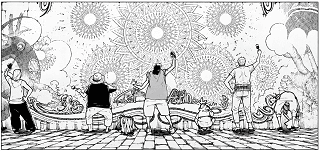
Gob imbued Canvas Town's outer walls with his Anima through his Protection Attachment ability — enchanting them with his intentions and feelings to physically nullify attacks and hostile intent from outsiders. These murals are still operational. The Mayor built Canvas Town specifically to ensure a safe place existed for people like Gob, and Gob's Anima is what made the safety possible. The reciprocal arrangement between the man who couldn't draw and the man who drew everything is the human architecture behind the town's existence.
The Deep Cave Paintings
In the sacred sites containing the Ground's historical record, Gob's painting is noted as being "the farthest in" — the deepest placed, the most advanced in physical position among all the Spellcasters who contributed to the record. The placement is a measurement of seniority and depth of contribution. His art here carries his thoughts and feelings as a psychic record — not decorative, but informational, accessible to future Givers who need to understand the Ground's history.
The Death
Gob died from body pollution. The cause was specific and avoidable: he kept removing his respirator mask while working in high-pollution No Man's Lands because the toxic zones were more inspiring than the safe ones, and the mask interrupted his connection to the environment. He became so consumed by the joy of drawing that the protocol disappeared from his decision-making entirely. It was not ignorance. It was a consistent, deliberate prioritisation of the work over the cost, maintained until the cost became terminal.
Enjin and the Mayor described his death to Rudo in Canvas Town. Both understood exactly what had happened and why. Neither presented it as something that could have been corrected by better advice.
Spellcaster Classification
Gob was a Spellcaster — a specialised class of Giver whose Anima is transmitted through ink, paint, and graffiti rather than through external objects wielded in combat. His art was not decorative and not simply expressive. It was functional: it carried his intentions into permanent physical effects on the objects he painted.
Protection Attachment
Gob's primary ability was Protection Attachment — imbuing a wall, surface, or object with his feelings and intentions to produce a permanent defensive enchantment. The walls of Canvas Town were enchanted through this ability to physically nullify attacks and hostile intent from outsiders. The enchantment persists after his death and does not degrade. He applied this ability across the town's outer walls during his years as a frequent visitor and resident Spellcaster, and the result is a defensive system that continues to function because his sincerity is embedded in the material.
Historical Recording
As a member of the Spellcaster lineage, Gob's art served as a psychic record — paintings that contained his thoughts and feelings and could be accessed by future Givers to understand the historical background of the Ground. His contribution to the deep cave sacred sites — noted as the farthest in among all historical Spellcasters — represents the most significant single body of recorded history available from one individual in the series.
Anima Quality — Elite
His placement as the deepest-contributing historical painter, the durability of his Canvas Town enchantments, and the specific choosing of him by the Cleaners for elite historical painting assignments all confirm his Anima quality as among the highest available during his operational period. Enjin, who often found Gob's behaviour difficult to understand, consistently respected the results of it.
Gob is depicted in flashbacks and Remlin's memories as a slender man of average height with a calm, focused expression. He had light-coloured, somewhat unkempt hair — the look of someone who was not paying attention to it because he was paying attention to something else. He wore a high-collared variant of the Cleaner uniform, almost always covered in paint or ink stains, and was frequently depicted with an artist's brush or the specialised stylus associated with his Spellcaster work.
In the final stages of his life, his appearance reflected the physical toll of body pollution — a frailer build, diminished from the version Remlin remembers training under. The progression is visible in the contrast between his earlier and later flashback depictions.
Remlin Tysark — His Chosen Successor
Remlin was Gob's surrogate little sister, student, and the person he chose to inherit both his role and his philosophy. He did not select her for technical skill alone — he selected her because she already understood that the true power of a Spellcaster was freedom and joy rather than just technique. The inheritance was ideological before it was positional: he gave her the philosophy first, and the role followed. She now protects Canvas Town using the same approach he taught her, and her Anima quality is understood by the town's residents as a continuation of what Gob built.
Gnomulas Ridd (The Mayor) — Friend and Mutual Beneficiary
The Mayor built Canvas Town specifically to create a safe place for artists like Gob — because he could never draw himself but admired those who could. Gob's murals are what made the town actually safe. The arrangement was reciprocal: the Mayor built the infrastructure, Gob provided the Anima protection. They were close friends, and the Mayor's grief at Gob's death was genuine and visible. The town exists because of both of them and continues to function because Gob's enchantments are still running in the walls.
Enjin — Former Teammate
Enjin respected Gob's skill and was frequently confused by his eccentricities. The description Enjin gave Rudo of Gob's philosophy — "Don't try too hard to understand an artist. Everything will stop making sense!" — is the most honest available summary of their working relationship: Enjin was the person who tried to understand and accepted the limitation; Gob was the person who kept removing his mask in poison zones. They worked together effectively. They saw the work differently.
Macaca Icol — Fellow Historical Spellcaster
Macaca Icol's work in the sacred caves sits adjacent to Gob's. Both were senior Spellcasters chosen for the historical painting assignments in the deep caves. The nature of their relationship has not been explored, but their co-authorship of the Ground's permanent historical record places them in a shared legacy that outlasts both of them.
- Gob is one of the few characters in the series shown to have successfully passed a non-blood-related legacy to a successor based on ideological compatibility rather than skill alone. He chose Remlin because she shared his philosophy of freedom and joy — not because she was the most technically advanced candidate available. The succession is a deliberate argument about what the work actually requires.
- His placement as the "farthest in" among all historical Spellcasters in the deep cave paintings marks him as the most senior contributor to the Ground's permanent historical record. The other Spellcasters painted from the entrance inward; Gob went deepest. Whether this is seniority by assignment, by willingness to go where others did not, or both has not been clarified.
- His murals on Canvas Town's outer walls are the series' clearest demonstration that Anima quality can outlast its creator. He is dead. His enchantments are still running. The sincerity he embedded in the paint when he was alive continues to function because it was genuinely put there — not maintained by his continued presence, but made permanent by how much he meant it.
- The specific mechanism of his death — removing his respirator mask in polluted zones because he found them more inspiring without it — is the series' most pointed illustration of the relationship between sincere obsession and self-destruction. He was not unaware of the danger. He was more interested in the painting than in managing the cost. This is the same quality that made his Anima exceptional and the same quality that made him impossible to protect from himself.
- The murals Rudo helps paint in Canvas Town are modelled after the style Gob established during his tenure. The series places Rudo in the specific aesthetic tradition Gob built — not symbolically but practically, painting in his manner on the same walls he enchanted.
- His name, "Gob," is short, informal, and slightly rough — consistent with someone the Mayor described as a person who "really just drew what he wanted and had fun with it." The name carries no ceremony or grandeur. He was a legendary Giver described in the most casual available terms by everyone who knew him, which is its own characterisation.
🇯🇵 Japanese Voice Actors
 Gotou, Hiroki
🇯🇵 Japanese
Gotou, Hiroki
🇯🇵 Japanese
 Marler, James
🇯🇵 Japanese
Marler, James
🇯🇵 Japanese